How to Capitalize Headlines in Blog Posts: A Practical Guide
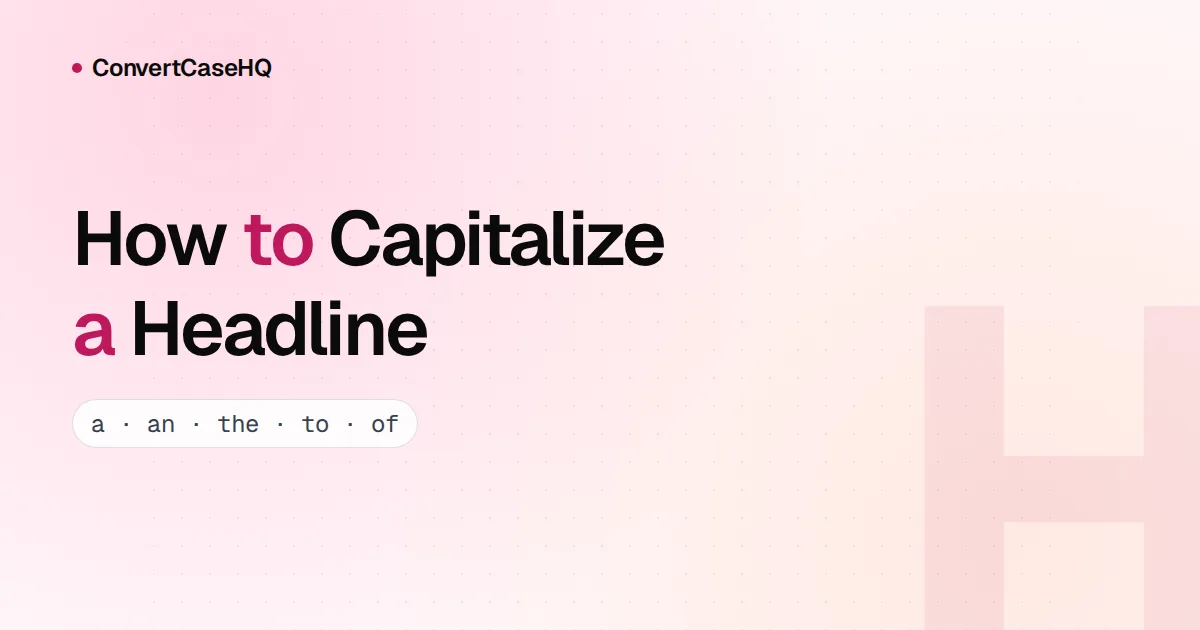
To capitalize a headline in title case, capitalize the first word, the last word, the first word after a colon, and every noun, pronoun, verb, adjective and adverb, however short. Lowercase the articles (a, an, the), the coordinating conjunctions (and, but, or, nor, for) and short prepositions (at, by, in, of, on, to). That's the whole system. The rest of this guide works through it step by step and covers the words that trip people up.
If you haven't yet settled whether your headlines should be in title case at all, start with our post on title case vs. sentence case. This one assumes you've chosen title case.
Step 1: Know what "short" means in your style guide
Every title-case system lowercases short prepositions, but the guides draw the line in different places. AP and APA capitalize prepositions of four letters or more, so "With," "From," "Into" and "Over" get capitals. Chicago, since its 18th edition in 2024, lowercases prepositions of four letters or fewer and capitalizes longer ones, so it writes "with" and "from" in lowercase but "About" and "Through" with capitals. A few conjunctions split too: AP and APA lowercase "yet," "so" and "if," while Chicago capitalizes them.
That's the only real fork in the road. Our side-by-side comparison of AP, Chicago and APA has the full table. The examples below use the AP and APA threshold and flag where Chicago differs. If you don't follow a published guide, pick a threshold anyway and write it down, because "it looked right" won't survive the next writer.
Step 2: Capitalize the first word, the last word and the word after a colon
These positions get a capital no matter what the word is. An article, a conjunction or a two-letter preposition at either end of the headline is capitalized:
- A Home to Go Back To (the final "To" is capitalized; this example comes straight from the Microsoft Writing Style Guide)
- The Best Ways to Cook a Steak
- Remote Work: A Practical Guide (the first word of a subtitle counts as a first word)
Step 3: Capitalize every major word, however short
Length only matters for prepositions and conjunctions. Nouns, pronouns, verbs, adjectives and adverbs are always capitalized, however few letters they have:
- Verbs, including every form of "be": Why Your Coffee Is Bitter, What to Do When Things Go Wrong
- Pronouns: Make It Count, Tell Us What You Think
- Adverbs, including "not," "too" and "very": This Is Not a Drill
- "This" and "that," which are always capitalized: The Question That Started It All
Short verbs and pronouns are the easiest words to get wrong, because they look like the function words you're about to lowercase. Check every "Is," "It," "Be" and "Do" before you publish.
Step 4: Lowercase the small function words
What's left after step 3 is mostly small function words. Three kinds stay lowercase in the middle of a headline:
- Articles: a, an, the
- Conjunctions: and, but, or, nor, for, plus (in AP and APA) other short ones such as yet, so and if
- Short prepositions: as, at, by, in, of, off, on, per, to, up, via, and in Chicago also four-letter ones such as with, from, into and over
Chicago keeps "to" lowercase even when it's part of an infinitive, as in the film title How to Train Your Dragon. "For" is lowercase whether it's acting as a preposition or a conjunction. And "as" is lowercase in all three major guides.
Step 5: Check words that change jobs
Some words are prepositions in one headline and adverbs in another, and the job decides the capital. The common case is a phrasal verb, where the little word is part of the verb rather than a preposition. Chicago states the rule outright: prepositions used as adverbs or adjectives are capitalized.
- How to Sign Up for Our Newsletter: "Up" belongs to the verb "sign up," so it's capitalized; "for" is a preposition, so it isn't.
- Log In to Your Account: "In" is part of "log in"; "to" is a preposition.
- Life in the Slow Lane: here "in" is a plain preposition, so it stays lowercase.
- Out of Office: "Out" is an adverb in this phrase and gets a capital; "of" doesn't. (Chicago's editors answered a reader's question about "out of" the same way.)
Watch the noun and verb spellings while you're there, because they cause capitalization slips. The verb is two words (Set Up Your Router, Back Up Your Files), while the noun or adjective is usually one (The Setup Guide, Backup Options).
Step 6: Treat hyphenated compounds part by part
The general rule is to capitalize each part of a hyphenated compound that would be capitalized on its own, and keep the articles, short prepositions and conjunctions inside it lowercase:
- Long-Term, Self-Paced, Copy-and-Paste
- Up-to-Date, Step-by-Step, State-of-the-Art
Two refinements are worth knowing. First, position matters: the Microsoft Writing Style Guide capitalizes the part after the hyphen when it's the last word, so it writes Microsoft Management Console: Five Essential Snap-Ins but Five Essential Snap-ins for Microsoft Management Console. Second, prefixes: Chicago's 18th edition now capitalizes the word after a prefix such as "anti-" or "non-" (Anti-Intellectuals), where earlier editions kept it lowercase. Older house styles may still write Anti-intellectual; just be consistent.
Step 7: Put names, brands and acronyms back the way they're spelled
Title case never overrides a name. NASA stays NASA, iPhone stays iPhone, eBay stays eBay, inside a headline as anywhere else. The awkward case is a lowercase-first brand at the very start. AP capitalizes the first letter at the start of a sentence or headline (IPhone), while Chicago says names like eBay and iPhone don't need a capital at the start of a heading, though some editors reword instead. Our advice is to reword: The iPhone Settings Worth Changing First sidesteps the question. Our guide to proper nouns and brand capitalization goes further.
Worked examples
| Draft | Title case (AP and APA) | Chicago difference |
|---|---|---|
| how to back up your iphone before an update | How to Back Up Your iPhone Before an Update | None |
| is it worth upgrading? a look at the numbers | Is It Worth Upgrading? A Look at the Numbers | None |
| working from home with kids: a survival guide | Working From Home With Kids: A Survival Guide | Working from Home with Kids |
| an up-to-date guide to self-hosted email | An Up-to-Date Guide to Self-Hosted Email | None |
| small but mighty: gadgets that are worth it | Small but Mighty: Gadgets That Are Worth It | None |
| fast yet cheap dinners if you hate cleaning up | Fast yet Cheap Dinners if You Hate Cleaning Up | Fast Yet Cheap Dinners If You Hate Cleaning Up |
Let a converter do the first pass
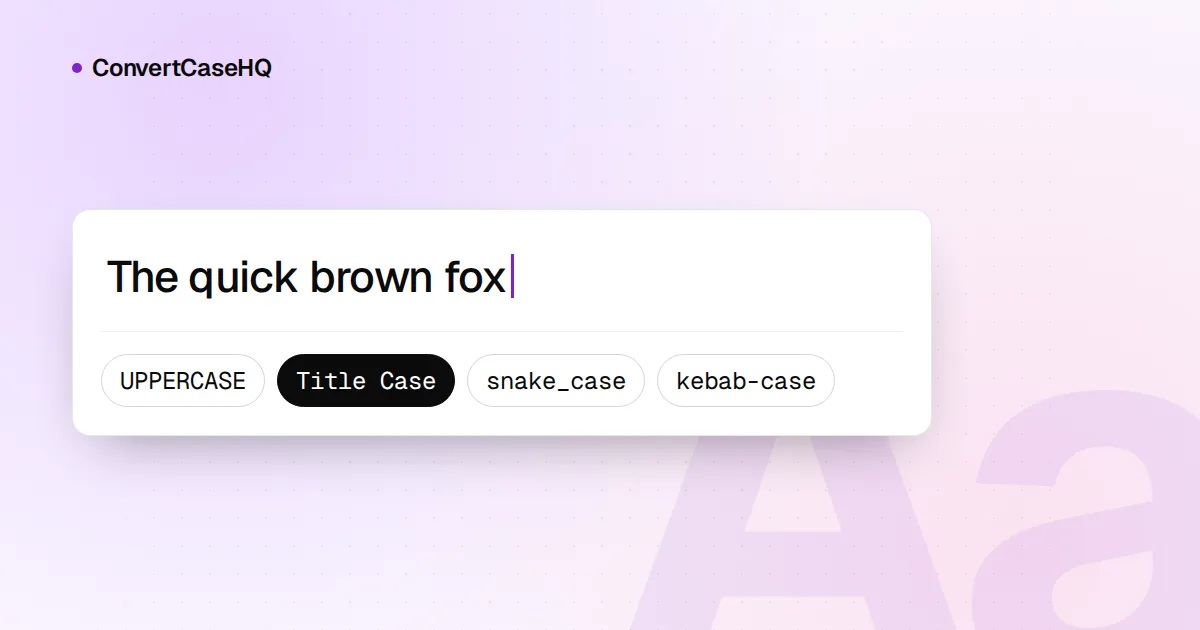
Paste a headline into our case converter and press Title Case, and most of the steps above happen at once. It keeps a fixed list of small words lowercase (a, an, the, and, but, or, nor, for, as, at, by, in, of, on, per, to, via, vs) and capitalizes everything else. Small words at the start or end of a line, or right after a colon, question mark, exclamation mark, full stop or dash, get a capital. Hyphenated parts are handled one at a time, so "up-to-date" comes out as "Up-to-Date."
Then do a quick manual pass for what a word list can't decide:
- Brands and acronyms. The converter keeps acronyms of up to four letters ("NASA") and names with capitals inside ("iPhone") as you typed them, unless the whole headline is in capitals. Longer acronyms, and anything that arrived in all caps, need putting back by hand.
- Phrasal verbs with "in," "on" or "by." Those words are on the list, so "log in to your account" comes out as "Log in to Your Account." Capitalize the particle yourself.
- Your guide's threshold. For AP or APA, lowercase "yet," "so," "if," "off" and prepositional "up," which aren't on the list. For Chicago, lowercase four-letter prepositions like "with" and "from."
The 30-second checklist
- First word, last word and the word after a colon: capitalized?
- Every noun, pronoun, verb, adjective and adverb capitalized, including "Is," "It," "Be" and "Not"?
- Articles, coordinating conjunctions and short prepositions lowercase, using your guide's idea of "short"?
- Phrasal-verb particles capitalized ("Sign Up," "Log In")?
- Each part of every hyphenated compound checked?
- Names, brands and acronyms spelled the way their owners spell them?