AP, Chicago, and APA: How Each Style Handles Capitalization
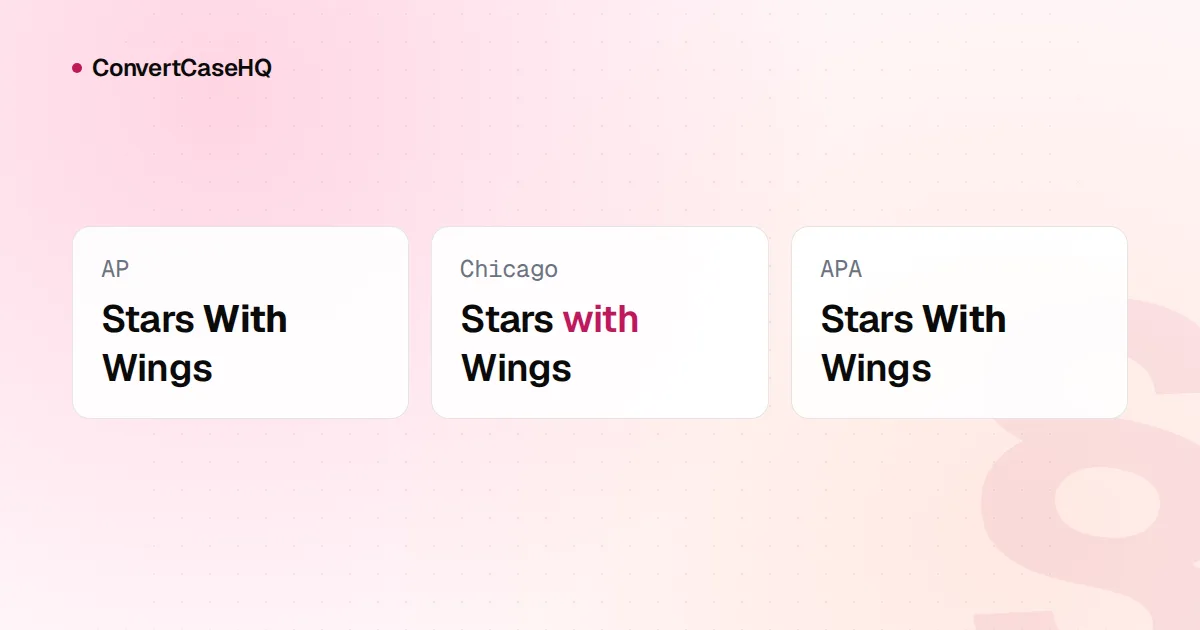
AP, Chicago and APA agree on most of title case: all three capitalize the first word and every noun, pronoun, verb, adjective and adverb, and all three lowercase articles and the conjunctions "and," "but" and "or." They split on short prepositions and a few conjunctions. AP capitalizes prepositions and conjunctions of four or more letters, and APA capitalizes every word of four or more letters. Chicago lowercases prepositions of four letters or fewer and, since its 18th edition in 2024, capitalizes longer ones. So "with" and "from" get capitals in AP and APA titles and stay lowercase in Chicago.
One warning before the details. A lot of advice online still says Chicago lowercases every preposition "regardless of length." That was Chicago's rule from its 12th edition (1969) through the 17th (2017). It changed in 2024.
The editions compared here
- The AP Stylebook, whose current print edition covers 2026 to 2028. AP also updates its online stylebook between print editions.
- The Chicago Manual of Style, 18th edition, published in 2024.
- The Publication Manual of the American Psychological Association, 7th edition, published in 2019 and still the current edition.
AP title capitalization: count to four
AP's rule for composition titles (books, films, plays, songs, TV shows, speeches, works of art) is to capitalize the principal words, including prepositions and conjunctions of four or more letters. Articles, and prepositions and conjunctions of fewer than four letters, are capitalized only when they're the first or last word. That's why AP writes Gone With the Wind with a capital W, where Chicago writes Gone with the Wind.
Two AP habits catch people out. First, AP puts composition titles in quotation marks, not italics. Second, AP doesn't use title case for news headlines at all: its headlines capitalize only the first word and proper nouns. So an AP-style publication might run a sentence-case headline about a title-case book.
Chicago title case: the 2024 change
Chicago's 18th edition made two changes that matter here. It renamed its styles, so "headline style" became title case and "sentence style" became sentence case. And it started capitalizing prepositions of more than four letters. The edition's own example in its preface is A Room with a View but Much Ado About Nothing.
The full Chicago rule set, in short:
- Capitalize the first and last words of titles and subtitles, and all major words.
- Lowercase articles (a, an, the).
- Lowercase prepositions of four letters or fewer, unless they're used as adverbs or adjectives (the "Up" in Sign Up).
- Lowercase the five common coordinating conjunctions: and, but, for, or, nor.
- Lowercase "to," including in infinitives, and "as" in any grammatical role.
Those rules produce a few results that surprise people coming from AP or APA. "Yet," "so" and "if" are capitalized, because they aren't among the five lowercase conjunctions. Chicago's editors have also confirmed that "that" is always capitalized in a title. And the 18th edition now capitalizes the part after a prefix in a hyphenated compound, giving Anti-Intellectuals rather than the older Anti-intellectuals.
APA title case: four letters for every word
APA 7 capitalizes:
- the first word of the title or heading, the first word of a subtitle, and the first word after a colon, em dash or end punctuation in a heading;
- major words: nouns, verbs (including linking verbs such as "is"), adjectives, adverbs and pronouns;
- every word of four letters or more, whatever its part of speech;
- both parts of a hyphenated major word.
It lowercases minor words of three letters or fewer: articles, short conjunctions (and, as, but, for, if, nor, or, so, yet) and short prepositions (as, at, by, for, in, of, off, on, per, to, up, via), unless they're the first word of the title or subtitle or follow a colon. AP and Chicago go one step further and capitalize the last word of a title too, whatever it is.
APA's four-letter test applies to every word, while AP's applies only to prepositions and conjunctions, but since both guides capitalize major words anyway, they produce the same title nearly every time. The bigger APA difference is where title case is used. APA uses it for a paper's title, its headings, table and figure titles, and titles of works mentioned in the text. In the reference list it switches to sentence case for the titles of articles, books and reports, keeping title case for journal names.
Side by side, word by word
| Word (mid-title) | AP | Chicago 18th ed. | APA 7th ed. |
|---|---|---|---|
| a, an, the | lowercase | lowercase | lowercase |
| and, but, or, nor, for | lowercase | lowercase | lowercase |
| yet, so, if | lowercase | Capitalized | lowercase |
| as | lowercase | lowercase | lowercase |
| at, by, in, of, on, to | lowercase | lowercase | lowercase |
| with, from, into, over, upon | Capitalized | lowercase | Capitalized |
| about, after, among, between, through | Capitalized | Capitalized (since 2024) | Capitalized |
| is, are, be | Capitalized | Capitalized | Capitalized |
| it, its, this, that | Capitalized | Capitalized | Capitalized |
| First word of the title or subtitle | Capitalized | Capitalized | Capitalized |
The same titles in all three styles
| AP | Chicago | APA |
|---|---|---|
| Working From Home Without Losing Your Mind | Working from Home Without Losing Your Mind | Working From Home Without Losing Your Mind |
| A Guide to Living Through the Winter With Less | A Guide to Living Through the Winter with Less | A Guide to Living Through the Winter With Less |
| Fast yet Cheap Dinners if You Hate Cleaning Up | Fast Yet Cheap Dinners If You Hate Cleaning Up | Fast yet Cheap Dinners if You Hate Cleaning Up |
Look at the first two rows under Chicago's 17th edition and you'd see "without" and "through" in lowercase too. That's the 2024 change in action: long prepositions now get capitals in all three guides, and the disagreement has shrunk to four-letter prepositions and a handful of short conjunctions.
Where the guides apply title case at all
Knowing the rules is half the job; the other half is knowing when they apply.
- AP: composition titles. News headlines are in sentence case.
- Chicago: titles of works in English, whether they appear in the text, a note or a bibliography. Chicago's editors have said they apply title case to a book title in all of those places.
- APA: the paper's own title, its headings, and titles of works named in the text, but sentence case for the same works in the reference list.
If you're weighing whether your own site should use title case for headings in the first place, our post on title case vs. sentence case covers that decision. For citations, numbers and the other places these guides part ways, see our MLA vs. APA vs. Chicago showdown.
Getting each style out of a converter
The Title Case button in our case converter keeps articles, "and," "but," "or," "nor," "for" and two- and three-letter prepositions lowercase, and capitalizes everything else. Out of the box, that's close to AP and APA for most titles. To finish the job:
- For AP or APA, lowercase "yet," "so," "if," "off" and "up" when they're working as conjunctions or prepositions.
- For Chicago, lowercase four-letter prepositions such as "with," "from," "into," "onto," "over" and "upon." The converter already capitalizes "yet," "so" and "if," which is what Chicago wants.
- For all three, check brand names and acronyms. The converter keeps short acronyms and names like "iPhone" as you typed them, but it can't repair a name that arrived in all caps or with the wrong capitals.
Our step-by-step headline capitalization guide covers the judgment calls a word list can't make, such as phrasal verbs and hyphenated compounds.
The one-line version
In AP and APA, a word of four letters or more gets a capital. In Chicago, a preposition needs five letters for a capital, and the other lowercase words are the articles plus "and," "but," "for," "or," "nor," "to" and "as." If you're checking Chicago against something you learned before 2024, read the preface to the 18th edition, which lists what changed.